An early look at how Mary Hamilton documented the rise of fingerprinting in America, exploring its adoption as a national method for identification and public safety in 1923.
Long before identification became routine in hospitals, schools, and government agencies, Mary E. Hamilton was leading the effort that made it possible.
As New York City’s first policewoman and founder of the New York School of Fingerprinting & Footprinting, Mary Hamilton transformed a forensic technique once associated solely with criminal investigation into a humanitarian safeguard—protecting children, families, soldiers, and victims of disaster.
Her mission was simple but radical for the era:
Identification exists not only to catch criminals — but to protect the innocent.
After receiving word that her son John had died in battle during WW1 — news later proven false — Mary devoted herself to fingerprint identification, determined to prevent the heartbreak of mistaken identity
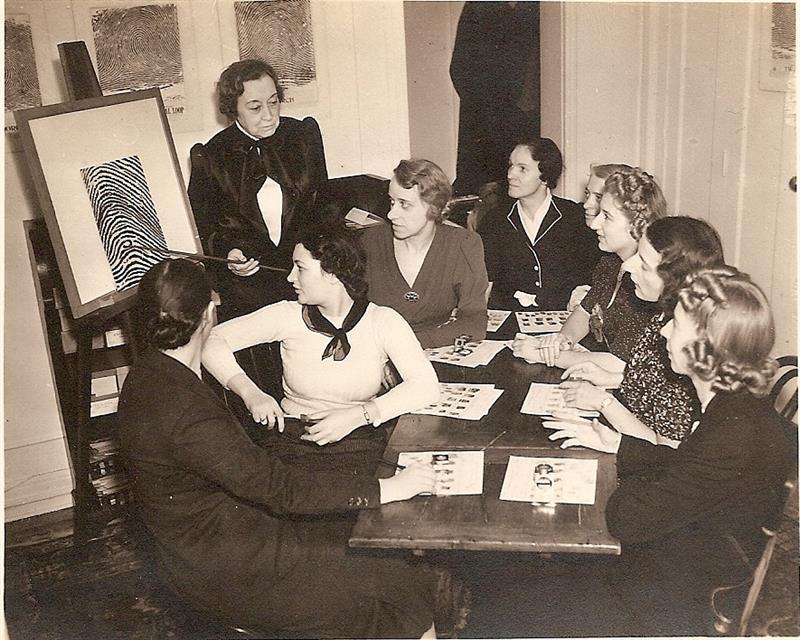
In the 1930s, Mary Hamilton developed what contemporary newspapers described as a “new field of employment for women” by establishing professional fingerprinting education accessible to nurses, teachers, social workers, and policewomen
HAMILTON_Mary article Daily New…
Students learned directly from Mary as she taught classes across New York City—demonstrated in training rooms, hospital wards, and classrooms nationwide.
Multiple articles photographed Mary instructing groups of professional women as they practiced collecting and analyzing prints with scientific precision.
Mary’s advocacy reframed fingerprinting away from criminal stigma and toward public safety.
Her writing and lectures repeatedly emphasized that:
The fingerprint is “the one signature which can never be forged.”
Unlike photographs or papers that can be lost, altered, or stolen, fingerprints offered irrefutable proof of identity when families were separated, when patients suffered amnesia, and when bodies were unidentifiable after accidents or war tragedies.
Mary became a national authority on baby footprint identification, believing it was society’s greatest untapped safeguard for children.
If a child were kidnapped tomorrow and not returned for years, what proof would parents have of identity?
Mary pushed for laws requiring universal infant footprinting, connecting the records directly to the Bureau of Vital Statistics so families could be protected from:
Articles from Popular Science Monthly documented Mary personally overseeing birth footprinting at maternity hospitals and demonstrating the technique for publishing audiences.
A tragic personal experience intensified Mary’s efforts.
During World War I, she was informed that her son had been killed in combat in France — only to later discover it was a false identification. The emotional trauma compelled her to campaign relentlessly for standardized identification systems to prevent:
By World War II, Mary was working with the U.S. Office of Civilian Defense to organize fingerprinting programs aimed at identifying children rendered homeless by air raids and wartime evacuations.
Mary’s work went beyond training — she built the civilian infrastructure for modern identification systems.
Fingerprinting expanded beyond police departments into civilian use, including:
Her advocacy directly influenced fingerprint requirements now standard for:
This transformation turned fingerprinting into what Mary referred to as:
“The shield of the innocent.”
Perhaps Mary’s greatest legacy is how she opened scientific identification to women at a professional level decades before it was socially common.
By founding the New York School of Fingerprinting & Footprinting, she enabled:
This transformation turned fingerprinting into what Mary referred to as:
“The woman who made fingerprinting accessible — and respectable — for women.”
Mary Hamilton’s fingerprinting movement laid foundations we now accept as routine:
Yet few people realize these safeguards grew directly from one woman’s relentless advocacy to place human dignity above suspicion.
Mary understood:
Identity isn’t about surveillance — it’s about belonging.
A collection of articles documenting her impact on forensic identification
An early look at how Mary Hamilton documented the rise of fingerprinting in America, exploring its adoption as a national method for identification and public safety in 1923.
Mary Hamilton examines the emerging science of footprinting in 1924, revealing how this new method expanded the possibilities of personal identification beyond fingerprints.
Mary Hamilton tells the emotional story of a mother who believed her son had died, only to uncover the truth in an unexpected and deeply moving turn of events.
A touching wartime piece by Mary Hamilton, capturing the emotional journey of a mother who believed her son was lost, only to learn he had survived—bringing an unexpected moment of hope during the war.
Mary Hamilton reports on a compelling human-interest story from 1938, capturing the struggles and resilience of ordinary people during a time of social and economic change.
Mary Hamilton offers a vivid 1937 human-interest report, shedding light on the everyday challenges and quiet strengths of community life during a period of national transition.
Mary Hamilton shares a poignant wartime account of a mother who believed her son had died, only to learn he was alive—an unexpected moment of hope amid the turmoil of 1942.
Mary Hamilton explores a compelling human-interest story in 1950, highlighting personal resilience and the unexpected twists that shape everyday lives.
Mary Hamilton reports on a notable 1940 human-interest story, highlighting personal courage and resilience amid the social and historical events of the time.
Mary Hamilton’s letter discusses the importance and methods of fingerprinting, emphasizing its role in identification and public safety.
A formal school letter authored by Mary Hamilton, reflecting official communication and record-keeping practices of the time.
Mary Hamilton contributes to The Emancipator, offering insights and commentary on social issues, advocacy, and community matters relevant to the period.
Mary Hamilton explores the use of fingerprinting in espionage, detailing how this technique became a crucial tool for security and intelligence operations.