The Day Mary Hamilton Took on a Gorilla

The Day Mary Hamilton Took on a Gorilla

November 13, 1932 — And Why Cameras Were Rolling.

On November 13, 1932, The Buffalo Times
published a feature titled:

“Big Thrills of New York’s Three Feminine Detective Chiefs.”

The article profiled three women serving in senior investigative roles in New York:

Mary E. Hamilton — A trailblazing New York policewoman who founded the Bureau of Missing Persons and became a national advocate for fingerprint identification, helping modernize investigative work across the country.

Belle Levy — One of New York’s earliest policewomen, noted for her fearless confrontations with armed criminals and her refusal to accept a limited role for women in law enforcement.

Ethel V. Asselta — A pioneering member of New York’s first generation of policewomen, recognized for her field work and commitment to expanding women’s active role in criminal investigations.

The piece celebrated their bravery — noting that these women had “dared guns and murder plots.”

Then it mentioned, almost as a side note, that one had nearly died “in the arms of a gorilla.”

That woman was Mary.
The full article can be downloaded here:

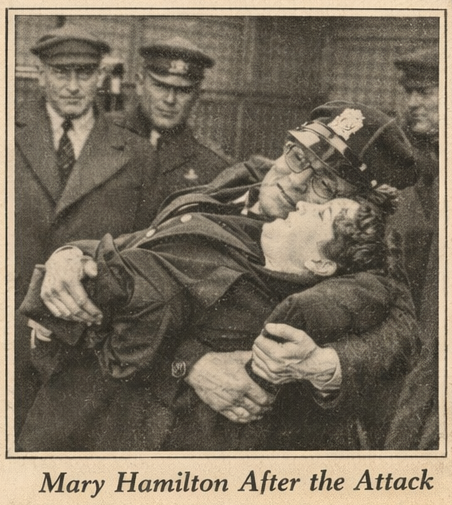
Mary getting squeezed by a gori…

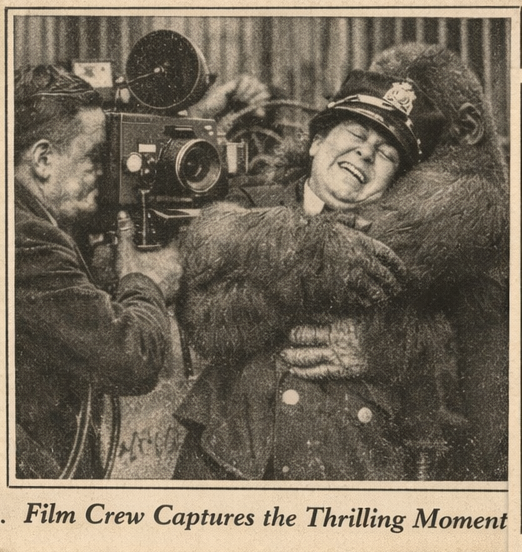
There Were Cameras in the Zoo

There were cameras present that day.

Not casual photographers.

Motion picture cameras.

Inside a steel cage at a New York zoo stood Mary E. Hamilton — New York City’s first policewoman, reformer, author of The Policewoman: Her Service and Ideals (1924), and a national voice for scientific identification.

She had entered the enclosure voluntarily.

Then the gorilla panicked.

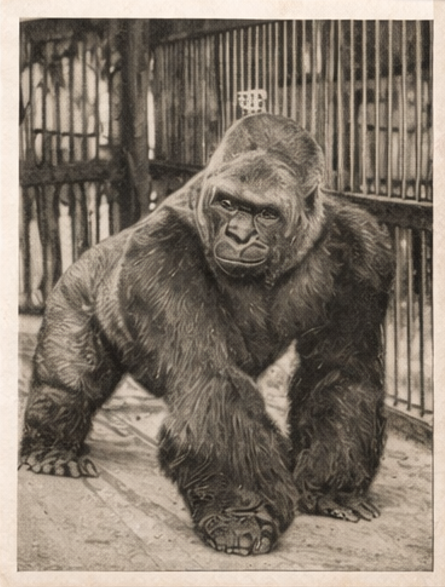
AI-Generated Image

AI-Generated Image

Why Fingerprint a Gorilla?

According to press accounts from 1932, the animal had initially tolerated the fingerprinting process. But the mechanical noise of the cameras startled it. In an instant, it reached for security — and seized her.

Witnesses reported she had to be pried from its grip.

She was carried out unconscious.

Four ribs broken.

Newspapers later summarized the episode with a touch of humor — “Mary getting squeezed by a gorilla.” But the headline softened what the moment actually represented.

She walked in willingly.

AI-Generated Image

AI-Generated Image

By the early 1930s, Mary had already transformed policing:

Organized New York’s Bureau of Missing Persons

Advanced fingerprint identification systems

Professionalized policewomen through civil service reform

Appeared as herself in the 1925 silent film Lilies of the Streets

Fingerprinting was her cause.

Years earlier, she had been mistakenly told her son had died in the war — a devastating case of misidentification that permanently reshaped her mission. Identity, to her, was not bureaucratic. It was human.

If even a gorilla possessed unique prints, the scientific case for universal identification grew stronger.

The zoo demonstration was not spectacle for spectacle’s sake. It was persuasion through proof.

But the presence of film cameras adds another layer.

Mary had already stepped into cinema once. Was this a newsreel? An educational short? Early promotional footage tied to her public campaigns?

We don’t yet know.

But she understood something rare for her era:

Reform required visibility.

Not Recklessness — Conviction

This was not the only time Mary had stepped toward danger.

She had:

Talked down an armed suspect while staring into a revolver

Confronted a murderer minutes after a subway killing

Received death threats

Lost her pension during the Depression and rebuilt her career by opening a fingerprinting school

She believed prevention demanded courage.

In 1924 she wrote:

“To cure is the voice of the past; to prevent, the divine whisper of today.”

She did not separate those ideas from action.

The Larger Pattern

The 1932 article framed the incident as thrilling — even theatrical. But it reveals something more enduring.

A woman reformer in a male-dominated institution physically demonstrating science.
A public campaign blending law enforcement and media.
An early recognition that identity — correctly established — prevents tragedy.

The gorilla’s grip lasted seconds.

The reforms she fought for reshaped modern policing.

November 1932.
A steel cage.
Four broken ribs.

And an idea strong enough to outlast them all.

Mary in the November 13, 1932 feature were two other formidable figures. Belle Levy, one of New York’s earliest licensed female investigators, built a reputation for stepping directly into danger — confronting armed criminals and refusing to accept the narrow, clerical roles society tried to assign women in law enforcement. And Ethel V. Asselta, a pioneering member of New York’s first generation of policewomen after their official appointment in 1918, carried her authority into the field, taking on investigative work at a time when most believed women belonged safely behind desks. Together, they represented something larger than individual bravery — they were proof that courage, once visible, changes institutions.

Discover more About mary hamilton

Fill out the form below, and we will be in touch shortly.